Building a Professional Social Media Presence in 2026
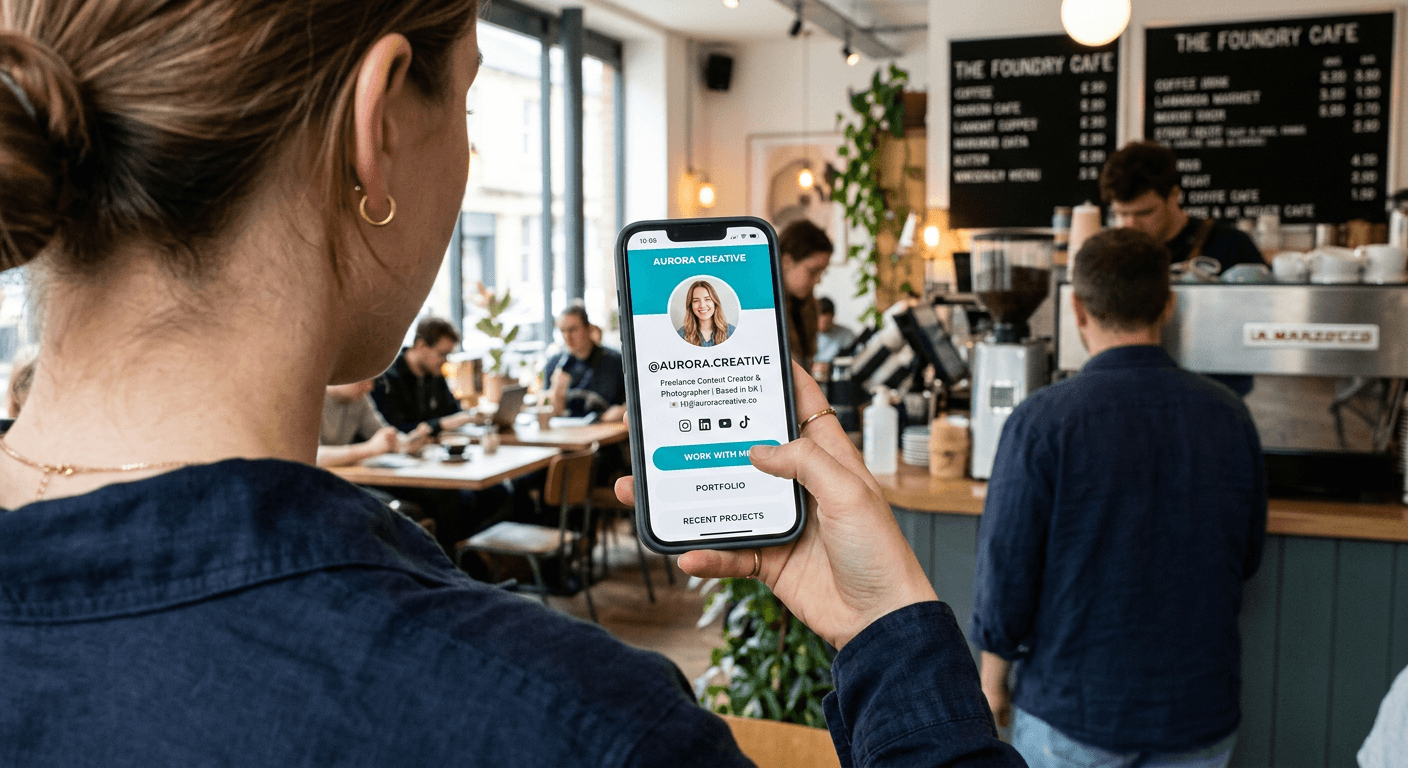
'Posting every day' is not a social media presence - it is simply generating free inventory for a platform you do not control. The most common assumption small business owners and creators make is that accumulating views is the end goal. It is not. Reach is rented, and algorithms change without warning. A professional social media presence only exists when you successfully bridge the gap between a fleeting impression in a feed and a deliberate action on an asset you actually own.
This article explains the mechanics of routing audience attention. We will look at how visual continuity builds trust, examine the specific ways businesses accidentally break their own traffic funnels, and outline the infrastructure required to turn passing scrollers into paying clients.
Quick Summary
A professional social media presence is the deliberate structuring of your online profiles to capture algorithmically generated attention and route it to an owned destination.
- Relying entirely on native platform reach leaves your business vulnerable to algorithmic shifts.
- Professional branding requires visual and operational consistency when a user clicks away from the platform.
- Centralised landing pages capture scattered traffic and direct it toward primary business objectives.
- Tracking off-platform behaviour is mandatory for measuring actual return on effort.
Table of Contents
- The Core Distinction: Rented Reach vs Owned Routing
- The Mechanics of Social Media Branding
- Three Ways Small Businesses Break Their Own Funnels
- The Infrastructure of a Centralised Exit
- Structuring the Landing Page for Conversion
- Who Benefits From Centralised Routing
- FAQ
- Recommended Reads
The Core Distinction: Rented Reach vs Owned Routing
Every major social platform operates on a closed-loop retention model. Their engineering objective is to keep users inside the application for as long as possible to serve them advertisements. When a platform gives a creator or an online shop a spike in organic reach, it is not doing so to help that business; it is doing so because that specific piece of content is successfully retaining user attention.
This creates a fundamental conflict of interest. Your objective is to extract the user from the platform to secure a sale, a booking, or an email signup. The platform's objective is to prevent them from leaving.
Understanding this tension changes how you structure your profiles. Amateurs treat their profile as a digital scrapbook. Professionals treat their profile as a departure lounge. Every element - the biography text, the pinned videos, the highlight covers - must serve a single operational goal: qualifying the viewer and pointing them toward the exit. If your profile does not feature a clearly signposted, frictionless route off the platform, you are operating a charity for a tech company's daily active user metrics.
To check if your presence is built for routing rather than just reach, look at your last five posts. If they all ask for engagement (likes, comments) but none direct the user to a specific link or external action, your presence is misaligned with your commercial goals.
The Mechanics of Social Media Branding
The phrase social media branding is routinely misunderstood as a styling exercise. Creators assume it means picking a hex code, applying a uniform preset to photographs, and writing a consistent tone of voice. While visual aesthetics are a component, professional branding is fundamentally about experiential continuity.
Trust is built through predictable interactions. If a user watches a highly polished, professionally lit video, taps the link in the biography, and is thrown onto a slow, unstyled directory page with broken links, the brand fractures instantly. The user experiences a cognitive disconnect between the promise made in the content and the reality of the destination.
Continuity requires the off-platform destination to inherit the design language of the profile that sent the traffic there. Custom domains, matching typography, and unified colour schemes signal to the user that they have not been redirected to a third-party spam site. This is particularly vital for freelancers and independent online shops where the entire operation relies on overcoming the initial hurdle of consumer scepticism.
Practical rule: Never send traffic from a curated social feed to an unbranded destination. The visual drop-off kills conversion faster than pricing ever will.
To audit your own continuity today, open your Instagram or TikTok profile on a mobile device, tap your own external link, and time how long it takes to figure out if the resulting page belongs to the same entity. If the branding requires a leap of faith to connect the dots, your bounce rate is artificially high.
Three Ways Small Businesses Break Their Own Funnels
When a social strategy fails to generate revenue, the common diagnosis is "the content isn't good enough." This is rarely the case. Usually, the content successfully generated attention, but the infrastructure failed to capture it. These failures fall into three distinct patterns.
1. The Dead-End Profile
The dead-end profile generates thousands of impressions but provides no mechanism for the audience to take the next step. The biography contains vague platitudes ("helping you live better") instead of a clear value proposition, and the single external link slot is either empty or points to a dormant homepage.
The symptom here is high engagement metrics paired with zero external traffic. The viewer finishes the video, clicks through to the profile, looks around, and leaves.
To fix this, the biography must act as an imperative command. Tell the user exactly what is waiting for them on the other side of the click: "Book a consultation," "Shop the winter range," or "Download the pricing guide."
2. The Fragmented Destination
A fragmented destination occurs when a business tries to do too many things natively. A creator might tell users to "DM for rates," "check out my YouTube channel," and "click the link for my shop" in the same breath.
Because users only have the capacity to remember one instruction, offering three different exit routes ensures they take none. Furthermore, manually pasting different URLs into the profile link slot every time a new product launches guarantees that older, viral content will point to irrelevant destinations.
The fix is a centralised landing page - a single URL that never changes in the profile, but houses dynamic buttons that update as campaigns shift.
3. The Unmeasured Exit
The third failure mode is relying entirely on native platform analytics. A social platform can tell you how many people tapped your link, but it cannot tell you what they did afterwards. If 500 people click through to your portfolio and zero people fill out the contact form, the platform analytics will still report that the campaign was a success.
Without an analytics pixel or off-platform tracking on the destination page, you have a blind spot exactly where the transaction happens. You cannot retarget interested users, and you cannot tell which social platform actually drives paying customers versus which one only drives window shoppers.
The Infrastructure of a Centralised Exit
Solving these funnel breakages requires specific technical infrastructure. You need a single, unified destination that can handle traffic from multiple social platforms simultaneously, track user behaviour, and display digital products or physical goods without requiring the user to navigate a complex menu system.
Historically, assembling this toolset required stringing together disparate services. A business would need to commission a dedicated routing site from a web designer, subscribe to a separate QR code builder to handle physical-to-digital bridging (like directing foot traffic from a pop-up shop to an online presence), pay for secure hosting, and integrate analytics tools. In the UK market, the traditional cost of maintaining this stack routinely totals upwards of £875 a month in combined software subscriptions and retainer fees.
Today, modern consolidated link platforms provide this entire infrastructure as a unified service. For around £7 a month, a creator or online shop can deploy a fully branded landing page, attach a custom domain, generate digital business cards, and plug in Facebook or Google tracking pixels.
The mechanism that makes this cost-effective is template standardisation. By removing the need to code bespoke CSS for every layout change, these platforms allow non-technical business owners to spin up high-converting landing pages in minutes. The page lives outside the social networks' walled gardens, meaning it remains entirely under the owner's control regardless of which app is currently popular.
Structuring the Landing Page for Conversion
A centralised landing page is only useful if it is structured correctly. Many businesses make the mistake of treating their unified link page like a filing cabinet, dumping every possible URL they have ever generated into a long, overwhelming list. This induces choice paralysis.
A high-performing destination page follows a strict visual hierarchy.
First, the top slot is reserved exclusively for the primary business objective. If you are a freelancer, this is your booking link. If you are an online shop, this is the current seasonal sale. This button should visually stand out from the rest, either through a contrasting colour or a subtle animation.
Second, the middle section houses secondary engagement points. This is where you link out to a YouTube channel, a newsletter signup, or a secondary product line.
Third, the bottom section is for static resources. Privacy policies, contact emails, and terms of service live here.
Practical rule: Never put more than five active links on a mobile-first routing page. If a user has to scroll down to see your primary offering, you will lose a third of your traffic before they even read the text.
You can verify your hierarchy right now. Look at your current external link page. Ask someone who does not know your business to look at it for three seconds and tell you what action they are supposed to take. If they cannot answer instantly, your hierarchy is broken and needs to be culled.
Who Benefits From Centralised Routing
Not every business requires a unified social media landing page, and pretending it is a universal solution is dishonest.
This infrastructure is strictly designed for transactional, fast-moving, or creator-led businesses. If you are a British creator monetising an audience, an online shop driving impulse purchases, or a freelancer offering packaged services, this setup is mandatory. Your audience is consuming content on their mobile phones during idle moments, and you have exactly five seconds to move them from a video to a checkout screen before they swipe away. Speed and clarity are the only things that matter.
Conversely, this approach does not suit enterprise B2B companies with complex, multi-stakeholder sales cycles. If your average contract value is £100,000 and requires six months of procurement reviews, a quick-tap landing page on Instagram is not going to close the deal. Those businesses require dense, multi-page corporate websites with heavy technical documentation. Using a lightweight routing page for heavy corporate sales signals a lack of depth.
However, for growing businesses that rely on turning public attention into immediate action, the centralised routing page is the most critical piece of digital real estate they own. It is the only place where the business, not the algorithm, sets the rules of engagement.
FAQ
Does changing my profile link frequently hurt my account reach? No, social platforms do not penalise accounts for changing their biography link. However, changing it frequently breaks the user journey for anyone discovering your older content. A permanent, centralised link prevents this dead-end.
Why is my website getting fewer visits than my link clicks show? This is usually due to page load times. If a platform registers a click but the user closes the browser before your heavy website loads, the click counts but the visit does not. A lightweight, mobile-optimised landing page solves this discrepancy.
Do I need a custom domain for a social link page? Yes, if you want to look professional. A branded custom domain prevents your business from looking like a temporary setup and significantly improves click-through rates by signalling trust to the user.
Can I track which social platform drives the most sales? Yes, provided your destination page supports tracking pixels and analytics integration. Relying purely on native app metrics will not show you the final conversion data.